HOW TO TURN SOCIAL MEDIA FOLLOWERS INTO CUSTOMERS: A COMPLETE GUIDE
Having thousands of social media followers may look impressive, but followers alone do not necessarily generate business. The real goal of social media marketing is to build relationships with the right audience and guide interested people toward becoming customers.
For small businesses, social media can be more than a platform for posting photos and videos. With the right strategy, it can help you build trust, generate leads, increase website traffic, and drive sales.
If you’re new to social media marketing, first learn the fundamentals in our Social Media Marketing for Small Businesses: A Beginner’s Guide. Once you have started building your audience, the next step is learning how to convert that audience into customers.
In this guide, you’ll learn practical ways to turn social media followers into potential customers and eventually paying customers.
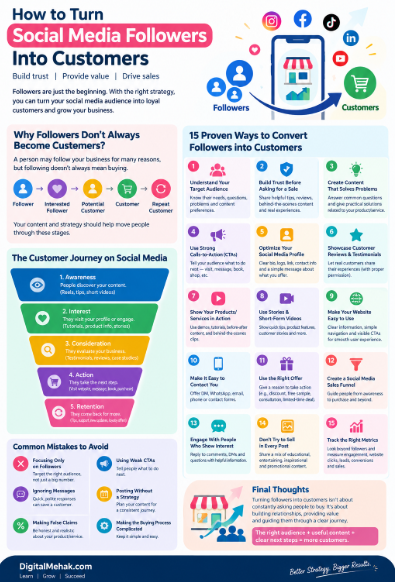
Why Followers Don’t Always Become Customers
A person may follow your business for many reasons. They might like your content, find your products interesting, or simply want to see what you post.
However, following a business does not automatically mean someone is ready to buy.
There is a difference between:
Follower → Interested follower → Potential customer → Customer → Repeat customer
Your social media strategy should help move people through these stages.
This means your content should not focus only on getting more followers. It should also give existing followers a reason to trust your business and take the next step.
1. Understand Your Target Audience
The first step toward converting followers is understanding who they are.
Ask yourself:
- Who is my ideal customer?
- What problem does my product or service solve?
- What information do they need before purchasing?
- What questions do they usually ask?
- What prevents them from buying?
- What type of content do they engage with?
For example, if you sell skincare products, your audience may want information about skin concerns, ingredients, product usage, and results.
When you understand your audience, you can create content that addresses their needs instead of simply promoting your products.
2. Build Trust Before Asking for a Sale
People are more likely to consider a business when they trust it.
Instead of constantly posting:
“Buy Now!”
create content that demonstrates your knowledge and credibility.
You can share:
- Educational tips
- Customer reviews
- Product demonstrations
- Frequently asked questions
- Behind-the-scenes content
- Case studies
- Tutorials
- Industry information
For example, a digital marketing agency could share tips about SEO, content marketing, social media, and website optimization before promoting its services.
This approach helps followers understand the value your business provides.
3. Create Content That Solves Problems
One of the easiest ways to attract potential customers is to solve their problems through your content.
Think about the questions your customers ask before purchasing.
For example:
A bakery:
- How should I choose a birthday cake?
- How many people does a 1 kg cake serve?
- How should a cake be stored?
A digital marketing agency:
- How can I increase website traffic?
- What is SEO?
- How does social media marketing help businesses?
A fitness business:
- What should beginners do before starting a workout?
- How often should you exercise?
- What are common beginner mistakes?
Helpful content can attract people who are already interested in the type of product or service you offer.
4. Use Strong Calls-to-Action
A follower may be interested in your content but still not know what to do next.
This is where a Call-to-Action (CTA) becomes important.
Instead of ending every post without direction, tell your audience what action they can take.
Examples include:
- Visit our website
- Send us a message
- Book a consultation
- Get a free quote
- Shop now
- Learn more
- Download the guide
- Contact us for details
For example:
Weak CTA:
“That’s all about social media marketing.”
Stronger CTA:
“Want to improve your social media presence? Send us a message to discuss your business goals.”
Your CTA should match the purpose of your content.
5. Optimize Your Social Media Profile
Your profile is often one of the first places potential customers visit after discovering your content.
Make sure your profile clearly communicates:
Who you are + What you offer + Who you help + How people can contact you
Your profile should include:
- Business name
- Professional profile image or logo
- Short business description
- Website link
- Contact information
- Location, if relevant
- Relevant call-to-action
A visitor should not have to search through dozens of posts to understand what your business does.
6. Showcase Customer Reviews and Testimonials
Social proof can help potential customers understand other people’s experiences with your business.
You can share:
- Customer reviews
- Testimonials
- Product feedback
- Before-and-after examples where appropriate
- Case studies
- User-generated content
Always use customer content responsibly and obtain appropriate permission before publishing identifiable customer material.
Instead of simply saying:
“Our product is amazing!”
showing genuine customer feedback can provide more useful evidence to people considering your product or service.
7. Show Your Products or Services in Action
People often want to understand how a product or service works before buying.
Use social media to demonstrate the value of what you offer.
You can create:
Product Demonstrations
Show how your product works.
Tutorials
Explain how customers can use it.
Before-and-After Content
Where appropriate and truthful, demonstrate a transformation.
Behind-the-Scenes Videos
Show how your product is created or how your service is delivered.
FAQs
Answer common questions about pricing, delivery, features, availability, or usage.
The more useful information you provide, the easier it can be for interested followers to evaluate your offering.
8. Use Stories and Short-Form Videos
Short-form video can be useful for demonstrating products, explaining concepts, answering questions, and showing behind-the-scenes content.
For example, a clothing business could create a short video showing:
New arrival → Product details → Styling idea → CTA
A service business could create:
Customer problem → Quick tip → Solution → CTA
Keep your videos focused on one clear idea rather than trying to explain everything in a single video.
9. Make Your Website Easy to Use
Getting someone from social media to your website is only one part of the customer journey.
Your website should make the next step simple.
Check whether your website has:
- Clear product or service information
- Easy navigation
- Visible contact information
- Simple inquiry or booking process
- Mobile-friendly design
- Clear calls-to-action
- Relevant landing pages
If someone clicks your social media link but cannot quickly understand what to do next, you may lose a potential customer.
10. Make It Easy to Contact You
Don’t make customers work too hard to reach your business.
Depending on your business, you could offer:
- Direct messages
- Phone
- Contact forms
- Booking forms
For local businesses, clearly displaying location and business hours can also help.
Your goal should be to reduce unnecessary steps between:
Interest → Inquiry
11. Use the Right Offer
Sometimes people need an additional reason to take action.
Depending on your business, this could include:
- First-order offer
- Free consultation
- Free sample
- Limited-time package
- Discount
- Free resource
- Trial
- Bonus service
However, don’t make discounts the foundation of your entire social media strategy.
Your offer should support the value of your product or service rather than replace it.
12. Create a Simple Social Media Sales Funnel
You can think of your social media strategy as a simple funnel:
Stage 1: Awareness
People discover your content.
Content examples:
- Reels
- Educational posts
- Tips
- Short videos
↓
Stage 2: Interest
They visit your profile or engage with your content.
Content examples:
- Tutorials
- Product information
- FAQs
- Stories
↓
Stage 3: Consideration
They start evaluating your business.
Content examples:
- Testimonials
- Reviews
- Case studies
- Demonstrations
↓
Stage 4: Action
They take the next step.
Examples:
- Visit website
- Send message
- Book appointment
- Request a quote
- Purchase
↓
Stage 5: Retention
After the purchase, continue providing value.
Examples:
- Helpful tips
- Product-use information
- Customer support
- New product updates
- Loyalty offers
This turns social media into more than just a platform for gaining followers.
13. Engage With People Who Show Interest
Pay attention to people who interact with your content.
Someone who repeatedly:
- Comments on your posts
- Asks questions
- Sends direct messages
- Saves your content
- Visits your website
- Responds to Stories
may be showing interest in your business.
Respond professionally and provide useful information rather than immediately pushing for a sale.
For example:
Customer: “How much does this service cost?”
Instead of simply replying with a price, you could provide the relevant package details and explain how they can contact you for a customized quote.
14. Don’t Try to Sell in Every Post
One of the biggest mistakes businesses make is turning every post into an advertisement.
A balanced content strategy could include:
- Educational content
- Entertaining content
- Inspirational content
- Engagement content
- Product/service content
- Customer content
This gives followers reasons to continue following your account even when they are not immediately ready to purchase.
15. Track the Right Metrics
To understand whether your social media strategy is actually helping your business, look beyond follower count.
Track metrics such as:
Engagement
Likes, comments, shares, and saves.
Profile Visits
How many people visit your profile after seeing your content?
Website Clicks
How many people click your website link?
Leads
How many people contact your business?
Conversion Rate
How many people who take a desired action eventually become customers?
Sales
How much revenue can reasonably be attributed to your social media efforts?
These metrics can help you understand what is working and what needs improvement.
Common Mistakes to Avoid
Focusing Only on Followers
A large audience isn’t automatically a large customer base.
Focus on attracting the right audience.
Using Weak CTAs
If you want people to take action, clearly tell them what to do.
Ignoring Messages
A potential customer who receives no response may move to another business.
Posting Without a Strategy
Random posts can make it difficult to build a consistent customer journey.
Making False Claims
Don’t exaggerate product results, testimonials, statistics, or business outcomes.
Trust is difficult to build and easy to lose.
Making the Buying Process Complicated
The fewer unnecessary steps between interest and purchase, the easier it is for customers to take action.
A Simple Example
Imagine you own a small bakery.
Instead of posting only:
“Buy our cakes!”
you could create a complete customer journey.
Post 1: Educational
“5 Things to Consider Before Ordering a Birthday Cake”
↓
Post 2: Product
“Here’s our latest customized birthday cake.”
↓
Post 3: Behind the Scenes
“Watch how we decorate this cake.”
↓
Post 4: Customer Review
Share an approved customer testimonial.
↓
Post 5: CTA
“Planning a birthday celebration? Send us a message to discuss your cake requirements.”
This approach provides information, builds interest, demonstrates the product, provides social proof, and gives the customer a clear next step.
Final Thoughts
Turning social media followers into customers is not about constantly asking people to buy.
It is about creating a clear journey:
Attract → Educate → Build Trust → Engage → Offer Value → Encourage Action → Retain Customers
Start by understanding your audience and creating useful content. Then optimize your profile, use clear calls-to-action, showcase customer experiences, make it easy to contact you, and track meaningful results.
Most importantly, remember that social media success isn’t only about how many followers you have. It’s about how effectively you connect with the right audience and turn genuine interest into meaningful business relationships.