Organic Growth: What It Is, Why It Matters, and How to Build Sustainable Growth in 2026
In today’s highly competitive digital world, businesses are constantly looking for ways to attract more customers, increase website traffic, and build a recognizable brand.
Paid advertising can deliver fast results, but there is another powerful approach that businesses should not ignore: organic growth.
Organic growth means building visibility, traffic, engagement, leads, and customers naturally through channels such as SEO, valuable content, social media, referrals, communities, email marketing, and word of mouth, rather than paying for every individual visit or interaction.
For a business that wants long-term digital success, organic growth is not simply a marketing tactic. It is a long-term growth strategy.
What Is Organic Growth?
Organic growth is the process of growing a business naturally without depending entirely on paid advertising.
For a digital business, organic growth can come from:
- Search engine optimization (SEO)
- Organic Google traffic
- Blog content
- Social media posts
- YouTube videos
- Email newsletters
- Customer referrals
- Online communities
- Word-of-mouth recommendations
- User-generated content
- Brand mentions
- Helpful educational content
For example, imagine someone searches Google for:
“How to improve Instagram marketing for a small business?”
They find your blog article, read it, visit your website, subscribe to your newsletter, and eventually become a customer.
You didn’t have to pay Google for that individual visit.
That is the power of organic growth.
Why Is Organic Growth Important in Today’s World?
The digital environment has changed significantly.
Customers are no longer dependent on traditional advertisements to discover businesses. They search Google, watch YouTube videos, read reviews, explore social media, ask communities, and increasingly use AI-powered search and recommendation tools.
HubSpot’s recent research describes organic marketing as increasingly important as consumers use search, AI answer engines, creators, and peer communities to make purchasing decisions.
This creates a major opportunity for businesses that consistently publish useful and trustworthy information.
Organic Growth vs Paid Growth
Both organic and paid marketing have an important role.
| Organic Growth | Paid Growth |
|---|---|
| Builds gradually | Can produce results quickly |
| Long-term strategy | Often campaign-driven |
| SEO and content focused | Advertising focused |
| Builds authority | Buys targeted visibility |
| Can continue generating traffic | Traffic generally stops when campaigns stop |
| Builds audience relationships | Useful for immediate reach |
| Requires consistency | Requires advertising budget |
The best strategy for many businesses is not organic OR paid.
It is:
Organic + Paid + Strong Brand
Paid campaigns can bring immediate visibility while organic marketing builds an asset that can continue generating attention over time.
10 Major Benefits of Organic Growth
1. Lower Long-Term Customer Acquisition Costs
One of the biggest benefits of organic growth is that a successful piece of content can continue attracting people after it is published.
For example, a useful SEO article can potentially generate visitors for months or even years.
With paid advertising, you generally pay to continue receiving exposure.
With organic content, the initial investment can continue producing value.
However, organic marketing is not “free.” It requires time, expertise, content creation, optimization, tools, and ongoing maintenance.
2. Builds Brand Trust
People often trust useful information more than advertisements.
Consider two situations:
Advertisement:
“Buy our digital marketing service. We are the best!”
Organic content:
“10 Digital Marketing Strategies Every Small Business Can Use.”
The second approach gives the audience something valuable before asking for a sale.
Over time, educational content can establish your business as a knowledgeable and trustworthy brand.
Google itself recommends creating helpful, reliable, people-first content rather than content designed primarily to manipulate search rankings.
3. Improves SEO Visibility
SEO is one of the strongest foundations of organic growth.
When your website consistently publishes useful content around topics your audience searches for, you create more opportunities to appear in search results.
For example, DigitalMehak.com could publish articles around:
- Digital marketing for beginners
- SEO tips for small businesses
- Social media marketing
- Google Ads
- Content marketing
- AI marketing
- Local SEO
- Email marketing
- Digital marketing tools
- Online business growth
Each useful article creates another opportunity for someone to discover your website.
But remember: publishing hundreds of low-quality articles isn’t the goal.
Google specifically advises against producing large amounts of content primarily to attract search-engine traffic.
4. Creates a Long-Term Marketing Asset
A good blog post, video, tutorial, case study, or guide can continue generating value after publication.
Think of content as a digital asset.
For example:
One high-quality article → Google traffic → social shares → backlinks → email subscribers → leads → customers
This is why content marketing can be so powerful.
HubSpot’s 2025 blogging research found that 50% of surveyed marketers reported higher ROI from blogging in 2024 compared with the previous year, while 56% of marketers at blog-producing businesses expected blogging’s role to expand in the future.
5. Increases Brand Awareness
Organic growth helps people discover your brand naturally.
Someone might find your:
- Google article
- Instagram Reel
- YouTube tutorial
- LinkedIn post
- Pinterest graphic
- Customer review
- Podcast
- Newsletter
Even if that person doesn’t buy immediately, they now know your brand.
Repeated exposure can gradually move people from:
Stranger → Visitor → Follower → Subscriber → Lead → Customer → Advocate
This is a powerful customer journey.
6. Generates More Qualified Traffic
Not all website traffic has the same value.
Someone who randomly sees an advertisement may have little interest in your product.
But someone searching:
“best digital marketing agency for small business”
already has a specific problem or intention.
Organic search can therefore attract people who are actively looking for information, solutions, products, or services.
This makes search-focused content particularly valuable for businesses with clear customer problems to solve.
7. Builds a Community
Organic marketing isn’t only about Google.
A strong organic strategy can also build communities through:
- YouTube
- Facebook Groups
- Email newsletters
- Online forums
- Creator communities
Community members can become repeat customers and brand advocates.
HubSpot’s social media research found that many marketers increasingly view social platforms as important discovery channels, with 84% of surveyed marketers agreeing that consumers would search for brands on social media.
8. Increases Customer Loyalty
Organic marketing allows businesses to communicate with customers even when they aren’t actively selling.
For example, a company can publish:
- Helpful tutorials
- Industry updates
- Customer stories
- Free resources
- Tips and checklists
- Educational videos
- Case studies
This creates ongoing value.
Customers may begin to see the brand as a resource rather than simply a company trying to sell something.
9. Supports Other Marketing Channels
Organic marketing doesn’t work in isolation.
A single blog article can become:
Blog → Instagram post → Reel → YouTube Short → LinkedIn post → Email → Pinterest graphic
This approach is called content repurposing.
Instead of creating completely new content for every platform, you can transform one strong idea into multiple formats.
This saves time and allows your message to reach people across different platforms.
10. Builds Authority in Your Industry
If your website consistently publishes accurate, useful and original information, it can gradually develop topical authority.
For example, DigitalMehak.com could become a useful resource for:
Digital Marketing + SEO + Social Media + AI Marketing + Online Business Growth
Instead of publishing random articles about unrelated subjects, focus on a clear niche.
Google recommends that websites maintain a clear purpose and create content that demonstrates knowledge, depth and value for their intended audience.
Organic Growth Statistics You Should Know
Organic growth is especially relevant in the current content and search environment.
1. Blogging remains important
HubSpot’s 2025 State of Blogging research found that 65% of surveyed marketers worked at companies that maintain blogs, and 93% of those marketers considered blogging important or very important to their marketing strategy.
2. Blog content remains a significant marketing format
HubSpot’s 2026 marketing statistics report says blog posts were among the top five highest-ROI content formats, with 22.26% of marketers identifying them as such.
3. SEO requires quality, not quantity
Google says its systems prioritize helpful, reliable information created primarily to benefit people, rather than content created mainly to manipulate search rankings.
4. Organic search is changing
AI-powered search and answer engines are changing how people discover information. This means businesses increasingly need content that is original, useful, expert-backed and genuinely valuable, rather than generic content that simply repeats information already available online.
How to Build an Organic Growth Strategy
Now let’s look at a practical strategy that a small business can follow.
Step 1: Define Your Target Audience
Before creating content, understand who you want to reach.
Ask:
- Who is my ideal customer?
- What problems do they have?
- What questions do they search for?
- Which social platforms do they use?
- What prevents them from buying?
The better you understand your audience, the better your content becomes.
Step 2: Build a Strong Website
Your website is the foundation of your organic growth strategy.
Make sure it has:
- Fast loading speed
- Mobile-friendly design
- Clear navigation
- Easy-to-read content
- Strong calls to action
- Contact information
- About page
- Author information where appropriate
- Secure HTTPS
- Clear service pages
- Blog section
Your website should make it easy for visitors to understand:
Who you are → What you offer → Why they should trust you → What they should do next
Step 3: Create Helpful Content
Don’t write content only because you found a keyword.
Write content because your audience has a problem.
For example:
Instead of:
“SEO”
Create:
“10 SEO Strategies Small Businesses Can Use to Get More Google Traffic”
Instead of:
“Instagram Marketing”
Create:
“How to Get Your First 1,000 Instagram Followers Organically”
Specific problems create better content opportunities.
Step 4: Focus on Topic Clusters
Instead of publishing random blog posts, build content around major topics.
For example:
Main Topic: SEO
Supporting articles:
- What is SEO?
- On-page SEO
- Technical SEO
- Local SEO
- Keyword research
- Link building
- SEO for beginners
- SEO tools
- SEO mistakes
- SEO trends
Then connect these articles using internal links.
This helps users navigate your website and creates a stronger topical structure.
Step 5: Use Social Media to Distribute Content
Publishing a blog is only the beginning.
Promote it through:
- YouTube
HubSpot’s blogging research found that 83% of surveyed blog-producing businesses distribute blog content through social media, showing how important distribution has become.
Step 6: Build an Email List
Social media platforms can change their algorithms.
Your email list is a direct communication channel.
Offer something useful in exchange for an email address, such as:
- Free SEO checklist
- Digital marketing guide
- Social media calendar
- Marketing templates
- Free ebook
- Beginner’s marketing course
Then send useful emails consistently.
Step 7: Encourage Reviews and Referrals
Satisfied customers can become one of your best organic marketing channels.
Ask customers to:
- Leave honest reviews
- Recommend your service
- Share their experience
- Create testimonials
- Tag your business
- Refer friends or colleagues
Real customer experiences can be more persuasive than traditional advertising.
Step 8: Measure Organic Growth
Don’t measure success only by website visitors.
Track:
SEO
- Organic clicks
- Impressions
- Search rankings
- Indexed pages
- Backlinks
- Organic conversions
Content
- Page views
- Engagement
- Time on page
- Leads
- Newsletter signups
Social Media
- Reach
- Engagement
- Profile visits
- Website clicks
- Followers
- Leads
Business
- Leads
- Customers
- Revenue
- Customer acquisition cost
- Repeat customers
The most important question is:
Is organic marketing contributing to business growth?
Common Organic Growth Mistakes
Organic marketing can fail when businesses make these mistakes.
Mistake 1: Expecting Immediate Results
Organic growth usually takes time.
SEO, content and community building are long-term activities.
Don’t publish three articles and expect thousands of visitors immediately.
Mistake 2: Creating Content Only for Keywords
Keywords matter, but people matter more.
Google explicitly recommends people-first content and warns against creating content primarily for search-engine traffic.
Mistake 3: Publishing Low-Quality AI Content
AI can help with research, brainstorming, outlining and editing.
But publishing generic AI-generated articles without expertise, original information, fact-checking or useful examples can make your website less valuable.
Use AI as a marketing assistant, not as a replacement for knowledge and experience.
Mistake 4: Ignoring Social Media
SEO is powerful, but don’t depend on one platform.
Distribute your best ideas across multiple relevant channels.
Mistake 5: Not Updating Old Content
Some content becomes outdated.
Review important articles periodically and update:
- Statistics
- Examples
- Links
- Screenshots
- Strategies
- Dates
- Recommendations
Make meaningful improvements rather than changing dates simply to make an article appear fresh. Google specifically cautions against doing that without substantial content changes.
Organic Growth Strategy for DigitalMehak.com
For DigitalMehak.com, a strong organic growth system could look like this:
Pillar 1: SEO
Create beginner-friendly SEO guides.
Pillar 2: Digital Marketing
Publish practical marketing strategies for businesses and beginners.
Pillar 3: Social Media
Create content about Instagram, Facebook, YouTube and LinkedIn marketing.
Pillar 4: AI Marketing
Explain how businesses can use AI responsibly and effectively.
Pillar 5: Business Growth
Publish content about lead generation, branding, customer acquisition and online business.
Pillar 6: Free Resources
Offer:
- Checklists
- Templates
- Marketing calendars
- Guides
- Tools
- Case studies
This can help DigitalMehak.com gradually become a valuable digital marketing resource.
Organic Growth Is a Marathon, Not a Sprint
One of the biggest misunderstandings about organic marketing is that it should produce immediate results.
It doesn’t always work that way.
Paid advertising can produce traffic today.
Organic growth may produce:
Small traffic → More content → More rankings → More visibility → More followers → More backlinks → More trust → More leads → More customers
The process takes time, but the results can compound.
That’s why organic growth is so valuable.
Final Thoughts
In today’s digital world, businesses need more than advertisements.
They need trust, visibility, authority, useful content and genuine relationships with customers.
Organic growth provides a way to build these assets over time.
SEO can bring search traffic.
Content can educate customers.
Social media can build communities.
Email can create direct relationships.
Reviews can build trust.
Referrals can bring new customers.
And a strong brand can connect everything together.
The key is consistency.
Don’t focus only on getting traffic. Focus on becoming valuable enough that people want to find you, follow you, trust you and recommend you.
That is the real power of organic growth.
At DigitalMehak.com, the goal should be simple:
Learn → Create → Share → Build Trust → Grow Organically.
SEO Details for WordPress
SEO Title: Organic Growth: Benefits, Strategies & Importance in 2026
Meta Description: Learn what organic growth is, why it matters in today’s digital world, its benefits, SEO strategies, content marketing tips, and how businesses can grow organically in 2026.
Focus Keyword: organic growth
Secondary Keywords:
- organic growth strategy
- organic marketing
- benefits of organic growth
- organic growth in digital marketing
- organic SEO
- organic business growth
- how to grow organically
- organic marketing strategy
Suggested URL Slug:organic-growth-benefits-strategies
Suggested Category:
Digital Marketing / SEO / Business Growth
Suggested Featured Image Text:
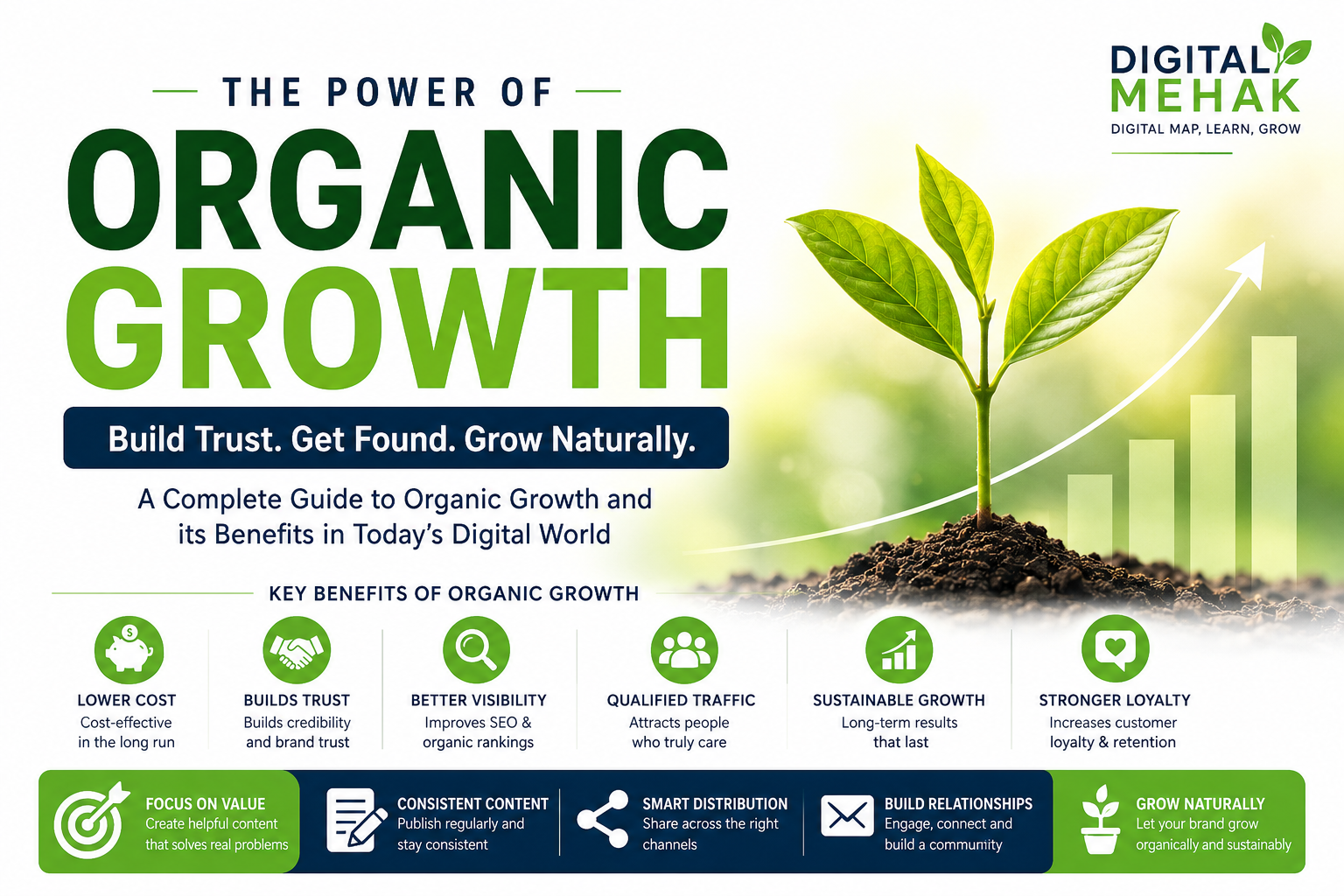
ORGANIC GROWTH
Build Trust. Get Found. Grow Naturally.
Suggested Internal Links:
Link this article to your DigitalMehak articles about SEO, digital marketing trends, social media marketing, AI marketing, content marketing, and local SEO as those articles are published.