Best Digital Marketing Trends in 2026: Statistics, Strategies & What Businesses Need to Know
For businesses in India and around the world, simply having a website or posting occasionally on social media is no longer enough. Successful brands need to understand where customers are spending their time, how they search for information, and what type of content they trust.
In this article, we explore the best digital marketing trends for 2026, along with useful statistics and practical strategies businesses can use to grow online.
Digital Marketing in 2026: Key Statistics
Before looking at individual trends, let’s understand the scale of today’s digital ecosystem.
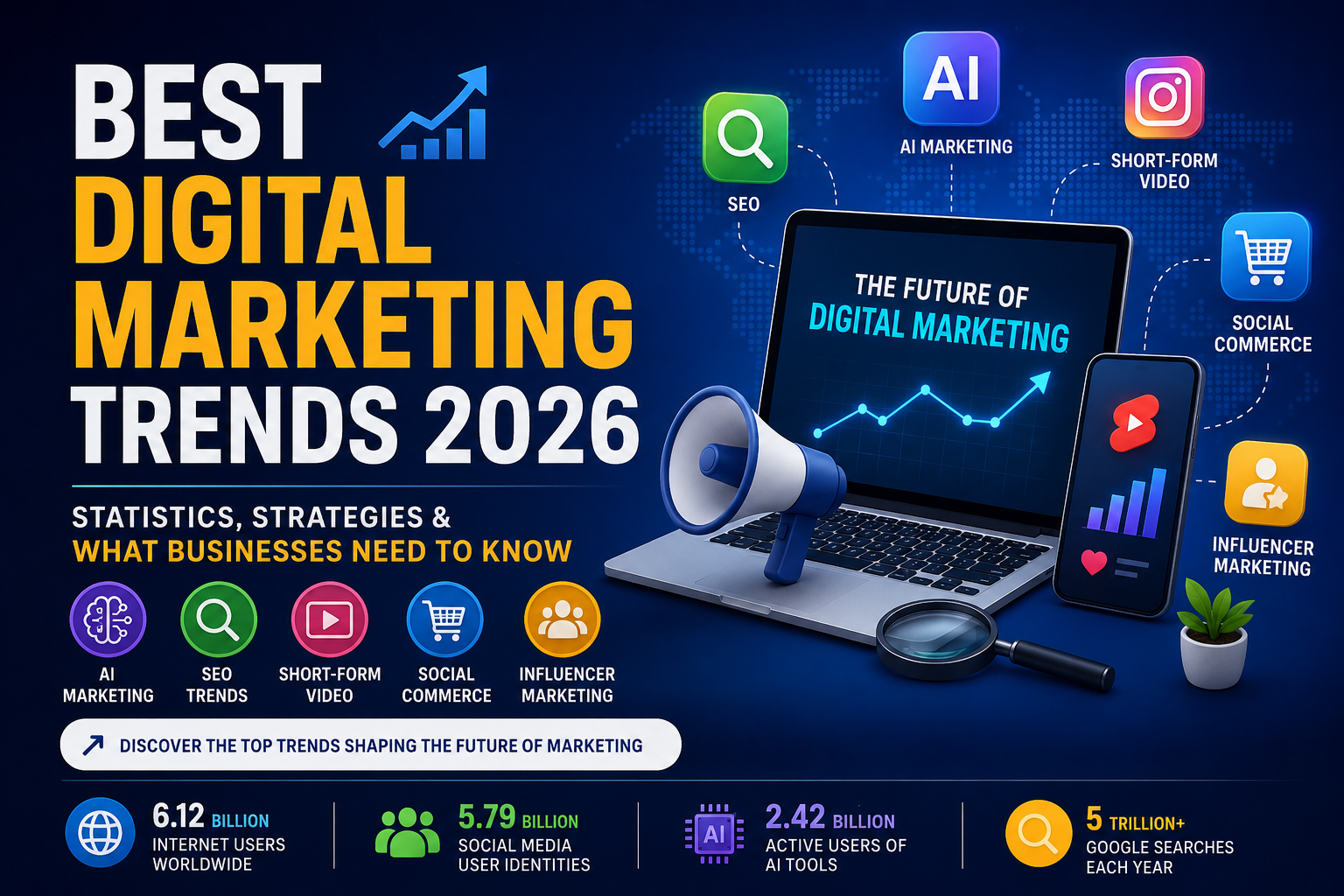
- More than 6.12 billion people were using the internet globally in April 2026, representing about 73.8% of the world’s population.
- Global social media user identities reached approximately 5.79 billion in April 2026.
- Generative AI tools had approximately 2.42 billion active users globally in April 2026, according to DataReportal’s analysis.
- Google processes more than 5 trillion searches annually.
- In the U.S. and India, Google says AI Overviews are driving more than a 10% increase in Google usage for the types of queries that display AI Overviews.
These numbers show one thing clearly: digital marketing is no longer optional for businesses that want to compete online.
1. Artificial Intelligence Is Becoming a Core Marketing Tool
AI is one of the biggest digital marketing trends of 2026.
Marketers are using AI for:
- Content ideas
- Blog writing and editing
- Market research
- Customer segmentation
- Ad copy
- Email personalization
- Data analysis
- Social media content
- Image and video creation
- Marketing automation
HubSpot’s marketing research found that 43% of marketers surveyed used generative AI for content creation, while 40% reported using it to learn how to do things and 35% for data analysis or reporting.
More recent HubSpot reporting also indicates that 64.5% of marketers say their organization uses AI moderately or extensively, although many teams still struggle with implementation.
How businesses can use AI
AI should not simply be used to produce large amounts of generic content.
Instead, businesses should use AI to:
- Research customer problems.
- Generate content ideas.
- Analyze campaign performance.
- Personalize communication.
- Automate repetitive marketing tasks.
- Help marketers make better decisions.
The winning approach is AI + human expertise, rather than AI replacing human creativity completely.
2. SEO Is Evolving Into AI Search Optimization
Search engine optimization is changing.
People are increasingly asking longer and more conversational questions, while Google is introducing AI-powered experiences such as AI Overviews and AI Mode.
Google says AI Overviews are now available in more than 200 countries and territories and more than 40 languages.
Google also reports that in major markets such as India and the United States, AI Overviews are associated with more than a 10% increase in usage for queries where the feature appears.
This means SEO strategies need to go beyond simply targeting keywords.
What should businesses focus on?
Create content that answers real questions clearly.
For example, instead of targeting only:
“Digital marketing course”
you could create content around:
- What is digital marketing?
- How can beginners learn digital marketing?
- How much does digital marketing cost?
- Which digital marketing skills are in demand?
- How can a small business get customers online?
This approach helps your website become useful for both traditional search and emerging AI-powered search experiences.
3. Short-Form Video Continues to Dominate
Short-form video remains one of the most important content formats.
Platforms such as:
- Instagram Reels
- YouTube Shorts
- TikTok
- Facebook Reels
have changed how people consume information.
HubSpot’s research found that short-form video was the most commonly used content format among surveyed marketers at 29%, and it was also the format most frequently identified as delivering the highest ROI, at 21%.
HubSpot’s social video research also found that Instagram, YouTube, and TikTok were among the strongest platforms for driving traffic, engagement, and audience growth.
What should you create?
Businesses can use short videos for:
- Product demonstrations
- Educational tips
- Customer testimonials
- Behind-the-scenes content
- Before-and-after videos
- Industry news
- Quick tutorials
- Frequently asked questions
A 30-second useful video can sometimes communicate an idea faster than a 1,500-word article.
4. Social Media Is Becoming a Search Engine
Social media is no longer only about connecting with friends.
People increasingly use social platforms to:
- Discover products
- Research brands
- Find restaurants
- Learn skills
- Watch reviews
- Compare products
- Find recommendations
DataReportal’s 2026 mid-year report says 96.7% of surveyed online adults reported using at least one social network or messaging platform each month, while 79.3% selected search engines and web portals.
This means businesses should optimize social profiles and content just as they optimize websites.
Social SEO tips
Use:
- Relevant keywords in captions
- Search-friendly video titles
- Clear profile descriptions
- Relevant hashtags
- Frequently asked questions
- Location information for local businesses
- Strong video hooks
For example, a digital marketing agency in Delhi could create content around:
“Best Digital Marketing Agency in Delhi”
but also answer questions such as:
“How much does digital marketing cost in Delhi?”
5. Social Commerce Will Keep Growing
Social platforms are increasingly becoming shopping destinations.
Customers can discover a product, watch a demonstration, ask questions and sometimes purchase without leaving the platform.
HubSpot’s research found that 17% of surveyed social media users had bought a product in-app during the previous three months, while 25% had purchased something based on an influencer recommendation.
This creates a powerful opportunity for ecommerce businesses.
Social commerce strategy
Brands should combine:
Content → Engagement → Trust → Product discovery → Purchase
Instead of constantly posting “Buy Now”, create useful content that helps customers make decisions.
6. Influencer Marketing Is Becoming More Authentic
Influencer marketing has evolved from celebrity endorsements to creator-driven communities.
Micro and niche creators can be particularly valuable because their audiences often trust their recommendations.
The most effective influencer campaigns are usually based on:
- Authenticity
- Niche relevance
- Product experience
- Storytelling
- Community engagement
- Long-term partnerships
A small creator with 20,000 highly relevant followers can sometimes be more valuable to a niche business than a celebrity with millions of followers.
Best strategy
Don’t choose an influencer only because they have a large follower count.
Look at:
- Engagement
- Audience demographics
- Content quality
- Niche relevance
- Previous brand collaborations
- Comments and audience sentiment
7. Personalization Will Become More Important
Customers don’t want generic marketing messages.
They expect brands to understand their interests and needs.
Personalization can include:
- Personalized emails
- Product recommendations
- Customized landing pages
- Location-based offers
- Personalized advertisements
- Retargeting campaigns
- Customer-specific content
For example, an ecommerce website can recommend products based on previous browsing or purchasing behavior.
The goal is simple:
Show the right message to the right person at the right time.
8. User-Generated Content Builds Trust
People often trust other customers more than traditional advertisements.
User-generated content, or UGC, includes:
- Customer reviews
- Testimonials
- Unboxing videos
- Customer photos
- Product demonstrations
- Social media mentions
- Video reviews
UGC can make a brand feel more authentic.
Instead of only telling customers:
“Our product is excellent.”
show real customers using and talking about it.
UGC strategy
Ask satisfied customers to:
- Share their experience.
- Post a photo or video.
- Tag your business.
- Leave a review.
- Answer a short testimonial question.
Always obtain appropriate permission before using customer content in your marketing.
9. First-Party Data Is Becoming More Valuable
Privacy changes are making businesses think differently about customer data.
Companies should build direct relationships with their audiences instead of depending entirely on third-party platforms.
Useful first-party data can include:
- Email subscribers
- Website interactions
- Purchase history
- Customer preferences
- CRM information
- Lead forms
- Customer feedback
A strong email list can become one of a company’s most valuable marketing assets.
10. Community Marketing Is Growing
Modern marketing is moving from simply collecting followers to building communities.
A community can exist through:
- Facebook Groups
- Telegram
- Discord
- Email newsletters
- Private customer groups
Community marketing works because customers don’t just interact with a company—they interact with each other.
For example, a digital marketing education brand could create a community where members share:
- SEO tips
- Marketing tools
- Campaign results
- Job opportunities
- Business questions
- Learning resources
This creates stronger long-term relationships than simply publishing advertisements.
11. Voice, Visual and Conversational Search
Search is becoming more conversational and multimodal.
People can search using:
- Voice
- Images
- Long questions
- Videos
- Screenshots
- Natural language
Google’s AI Search developments are designed to support more complex and multimodal queries.
For marketers, this means content should be written in a way that naturally answers customer questions.
Instead of writing only for search engines, write for humans who are trying to solve a problem.
12. Data-Driven Marketing Will Beat Guesswork
Digital marketing produces enormous amounts of data.
Businesses can measure:
- Website visitors
- Traffic sources
- Conversion rates
- Cost per lead
- Customer acquisition cost
- Return on ad spend
- Email open rates
- Social engagement
- Sales
The important thing is not to collect every possible metric.
Instead, focus on metrics connected to business goals.
Example
If your goal is lead generation, focus on:
Visitors → Leads → Qualified Leads → Customers → Revenue
This is more useful than focusing only on likes and followers.
13. Content Repurposing Will Save Time
Creating content from scratch for every platform can take a lot of time.
A smarter strategy is to create one strong piece of content and repurpose it.
For example:
One blog post can become:
- 1 YouTube video
- 3 Instagram Reels
- 5 social media posts
- 1 LinkedIn article
- 1 email newsletter
- 10 social media tips
- 1 infographic
AI tools can help marketers transform content into different formats, while humans maintain the brand voice and quality.
This creates a content ecosystem rather than isolated pieces of content.
14. Local SEO Remains Essential for Small Businesses
For local businesses, appearing in search results when people search nearby can generate highly valuable leads.
Businesses should optimize:
- Google Business Profile
- Website location pages
- Reviews
- Local keywords
- Business name, address and phone information
- Local content
- Maps presence
For example:
“Digital marketing agency in Chandigarh”
can attract a much more targeted audience than simply targeting:
“Digital marketing agency.”
Local SEO is particularly important for service businesses that depend on customers from a specific city or region.
15. The Future of Digital Marketing Is Omnichannel
Customers rarely follow a simple path such as:
Google → Website → Purchase
A modern customer journey might look like:
Instagram → Google Search → YouTube → Website → WhatsApp → Review → Purchase
Google’s research on Indian consumers highlights how people move across multiple digital touchpoints, from search and entertainment to social feeds and shopping.
Therefore, brands need to provide a consistent experience across multiple channels.
Top Digital Marketing Trends for 2026 at a Glance
| Trend | Key Opportunity |
|---|---|
| AI Marketing | Automation, content and analytics |
| AI Search | Optimize content for conversational search |
| Short-Form Video | Reach and engagement |
| Social SEO | Get discovered inside social platforms |
| Social Commerce | Turn social discovery into sales |
| Influencer Marketing | Build trust through creators |
| Personalization | Improve customer experience |
| UGC | Build authenticity and social proof |
| First-Party Data | Build direct customer relationships |
| Community Marketing | Increase loyalty |
| Voice & Visual Search | Adapt to new search behavior |
| Data-Driven Marketing | Improve ROI |
| Content Repurposing | Produce more content efficiently |
| Local SEO | Generate local leads |
| Omnichannel Marketing | Connect the complete customer journey |
How to Create a Digital Marketing Strategy in 2026
Following every trend isn’t necessary.
Instead, businesses should choose the trends that match their customers and goals.
Step 1: Define your target audience
Understand:
- Who are your customers?
- What problems do they have?
- Where do they spend time online?
- What questions do they ask?
Step 2: Choose your primary channels
For example:
B2B: SEO + LinkedIn + Email
Ecommerce: Instagram + YouTube + SEO + Paid Ads
Local Business: Local SEO + Google Ads + Instagram + WhatsApp
Personal Brand: YouTube + Instagram + LinkedIn + Email
Step 3: Create useful content
Focus on answering customer questions rather than constantly promoting products.
Step 4: Use AI strategically
Use AI for research, analysis, ideation and repetitive tasks—but keep human expertise, originality and fact-checking at the center.
Step 5: Measure results
Track leads, conversions and revenue—not just impressions and likes.
Final Thoughts
Digital marketing in 2026 is becoming more intelligent, visual, conversational and customer-focused.
The biggest opportunities are not simply about using the newest tool. They are about combining AI, quality content, SEO, short-form video, social media, personalization, data and genuine customer relationships.
Businesses that adapt early can build stronger digital visibility and create more opportunities for growth.
At DigitalMehak.com, our goal is to make digital marketing easier to understand and more practical for businesses, marketers, students and entrepreneurs.
The future belongs to brands that don’t just advertise online—they educate, engage, build trust and create value.
Which digital marketing trend will have the biggest impact on your business in 2026?
Sources & Further Reading
- DataReportal — Digital 2026 Mid-Year Global Update
- Google — AI in Search and AI Overviews
- Google India — Marketing, Search and YouTube
- HubSpot — State of Marketing & Trends
- HubSpot — Social Media Video Trends
SEO Title: Best Digital Marketing Trends in 2026: Statistics & Strategies
Meta Description: Discover the best digital marketing trends for 2026, including AI marketing, SEO, short-form video, social commerce, influencer marketing, personalization and the latest statistics.
Suggested URL Slug: digital-marketing-trends-2026
Focus Keyword: digital marketing trends 2026
Secondary Keywords: digital marketing trends, AI marketing, SEO trends 2026, social media marketing trends, digital marketing statistics, online marketing trends